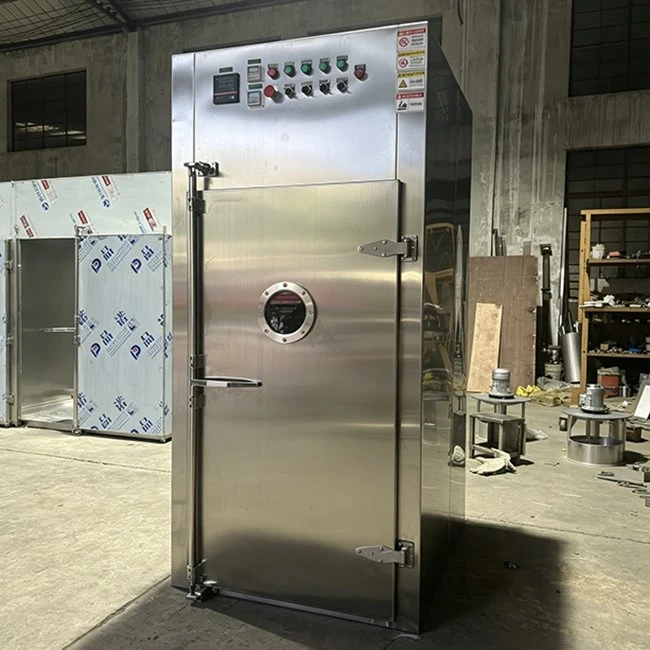
Yo, what’s up everyone! I’m an industrial oven supplier, and today I wanna chat about something super important in the oven biz: the effects of different airflow rates in an industrial oven. You see, airflow rate isn’t just some random number; it can make or break the performance of your oven and the quality of your products. So, let’s dive right in! Industrial Oven
1. The Basics of Airflow in Industrial Ovens
First things first, let’s talk about what airflow in an industrial oven actually does. Airflow is all about moving hot air around inside the oven. This movement helps to transfer heat evenly to whatever you’re baking, drying, or curing. In simple terms, good airflow means better heat distribution.
Now, there are two main types of airflow in industrial ovens: natural and forced. Natural airflow happens when hot air rises and cool air sinks, creating a kind of gentle circulation. It’s like a slow – moving thermal dance. On the other hand, forced airflow is where we use fans to push the air around. This gives us more control over how the air moves.
2. Effects of Low Airflow Rates
Uneven Heating
One of the biggest problems with low airflow rates is uneven heating. When the air isn’t moving around much, some parts of your product might get more heat than others. For example, if you’re baking a batch of parts in the oven, the ones closer to the heat source will get cooked faster, while the ones farther away will be undercooked. This can lead to a whole lot of quality issues. You might end up with parts that are brittle in some areas and not fully cured in others. It’s like getting a pizza where one slice is burned and the other is still raw.
Longer Processing Times
Low airflow also means longer processing times. Since the heat isn’t being transferred efficiently, it takes more time for your product to reach the desired temperature. This is a huge deal in an industrial setting because time is money. Longer processing times mean lower productivity and higher costs. You’re basically paying your oven to work harder and longer just because the air isn’t moving fast enough.
Moisture Build – up
Another effect of low airflow is moisture build – up. When the air isn’t circulating well, moisture can’t escape from the oven easily. This can cause problems like rusting for metal parts or warping for wood or plastic components. It’s like leaving a wet towel in a closed room; it’ll just stay wet and start to smell bad!
3. Effects of High Airflow Rates
Rapid Heat Transfer
The good thing about high airflow rates is that they can transfer heat really quickly. This means shorter processing times and higher productivity. If you need to get a large batch of products out in a hurry, a high – airflow oven can be a real lifesaver. It’s like having a turbo boost for your baking or curing process.
Uniform Heating
High airflow also helps to ensure more uniform heating. The fast – moving air spreads the heat evenly across all parts of the product. So, you’re less likely to have those hot and cold spots that can cause quality issues. It’s like having a well – mixed pot of soup; every spoonful tastes the same.
Product Damage
However, there are also some downsides to high airflow. One of the main problems is that it can cause product damage. The strong air currents can blow small parts around or even cause them to break. If you’re working with delicate items, like thin – walled plastic parts or small electronic components, high airflow can be a nightmare. It’s like a strong wind blowing over a sandcastle; it can easily knock it down.
Energy Consumption
High airflow also means higher energy consumption. The fans that create the high airflow use a lot of electricity. So, while you might be saving time, you could be spending more on energy costs. It’s a bit of a trade – off between speed and efficiency.
4. Finding the Right Airflow Rate
So, how do you find the right airflow rate for your industrial oven? Well, it depends on a few factors.
Product Type
The type of product you’re processing is a big factor. If you’re working with large, dense products, you might need a higher airflow rate to ensure even heating. On the other hand, if you’re dealing with small, delicate items, a lower airflow rate could be better to avoid damage.
Processing Time
Your desired processing time also matters. If you’re in a rush to get products out, you might want to go for a higher airflow rate. But if you have more time and are more concerned about energy costs, a lower airflow rate could be the way to go.
Oven Size
The size of your oven is another consideration. Larger ovens usually need higher airflow rates to ensure that the heat is evenly distributed throughout the entire space. Smaller ovens might be able to get away with lower airflow rates.
5. Our Solutions as an Industrial Oven Supplier
As an industrial oven supplier, we understand the importance of getting the airflow rate right. That’s why we offer ovens with adjustable airflow systems. You can easily change the airflow rate depending on your specific needs.
We also have a team of experts who can help you figure out the best airflow rate for your products. We’ll take into account all the factors we’ve talked about, like product type, processing time, and oven size. We’ll work with you to customize a solution that fits your exact requirements.
Whether you need a high – airflow oven for fast processing or a low – airflow option for delicate items, we’ve got you covered. Our ovens are built with the latest technology to ensure efficient and reliable performance.
6. Conclusion and Call to Action

In conclusion, the airflow rate in an industrial oven has a huge impact on the quality of your products, processing times, and energy costs. Finding the right balance is key.
Industrial Furnace If you’re looking for an industrial oven that can deliver the perfect airflow rate for your needs, we’re here to help. We’ve got the experience, the technology, and the expertise to provide you with the best solution. Don’t hesitate to get in touch with us to start a conversation about your industrial oven requirements. Let’s work together to make your production processes more efficient and your products of higher quality.
References
- "Industrial Oven Handbook," A. Smith, 2020
- "Airflow Dynamics in Industrial Heating Processes," B. Johnson, 2019
- "Optimizing Airflow for Better Product Quality in Ovens," C. Williams, 2021
Nanjing Ranran Tiancheng Drying Equipment Co., Ltd.
As one of the most professional industrial oven manufacturers and suppliers in China, our products have good reputation in the market. Please feel free to buy advanced industrial oven for sale here from our factory. All customized products are with high quality and competitive price.
Address: No. 5 Xinhua Road, Shangba Village, Longtan Street, Qixia District, Nanjing City
E-mail: rrtc@rrtcoven.com
WebSite: https://www.rrtcoven.com/
